
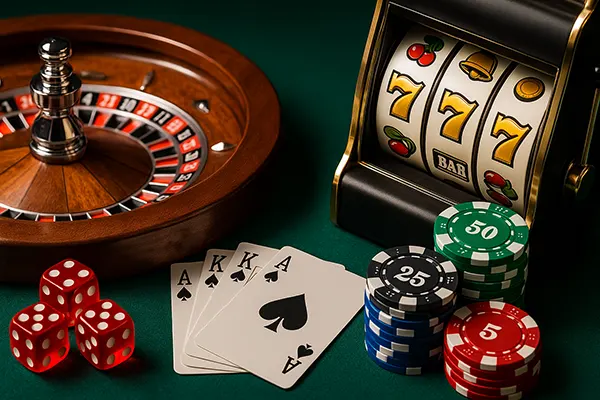
Table Games vs Slots: How Probability Strategies Shift for Different Player Types
Understanding how probability behaves across various casino game categories helps players align their approach with the mechanics behind each game type. Table games and slots differ significantly in how outcomes are generated, how strategies influence results, and how risk profiles suit individual playing styles. This comparison highlights the practical aspects of probability as applied in 2025, offering clear insights for those who want to make informed choices based on data rather than intuition.
Core Probability Principles Behind Table Games
Table games generally operate on mathematically transparent probability models. Games such as blackjack, baccarat or roulette follow fixed rules where the range of possible outcomes is known and measurable. This allows players to base decisions on predictable factors, such as the number of remaining cards in a shoe or the distribution of outcomes on a roulette wheel.
A key characteristic of table games is that player actions can influence long-term expected outcomes. While the house retains a statistical edge, the ability to make decisions—such as splitting, doubling or choosing which bets to place—gives players partial control over their expected value. This distinguishes table games from slots, where the outcome is fully automated.
For probability-driven players, table games create an analytical environment that rewards understanding of rules, odds and situational strategy. Those who prefer calculated decision-making tend to gravitate toward games where each action carries measurable impact, especially when consistent play is guided by clear mathematical reasoning.
How Player Strategy Changes Expected Outcomes
Blackjack provides one of the clearest examples of strategic influence on probability. Basic strategy charts, derived from computer-simulated calculations, reduce the house edge to a minimal level when applied correctly. The player does not eliminate the edge, but trims it significantly by aligning decisions with optimal probabilities for every hand combination.
Baccarat, while mechanically simpler, also features predictable probability distributions. Since the banker bet holds a marginally lower house edge due to the drawing rules, many players use a consistent betting pattern based on this statistical advantage. Although the difference is small, it remains a mathematically sound approach compared with more speculative alternatives.
Roulette illustrates the contrast between different wheel formats. The European wheel’s single zero provides slightly better odds compared with the double-zero American version. This small change alters probability enough to influence long-term outcomes for disciplined players who rely on structured betting patterns and risk-management strategies.
How Slots Apply RNG-Based Probability
Slots in 2025 rely entirely on certified Random Number Generators (RNGs), ensuring each spin is independent with no memory of prior results. Unlike table games, probability here is embedded in the design rather than expressed through visible mechanics. Players cannot use strategy to shift expected results; instead, outcomes follow programmed return-to-player percentages and hit frequencies.
The probability model behind modern video slots includes additional layers, such as volatility ratings, bonus triggers and event frequencies. These elements collectively determine how often wins occur and how large they may be. High-volatility games offer fewer wins but potentially larger payouts, while low-volatility titles prioritise steady but modest returns.
Due to these structural characteristics, slot probability favours players who prefer entertainment-driven gameplay rather than analytical optimisation. The experience is shaped by anticipation and pacing rather than strategic calculation, with long-term results defined by built-in mathematical parameters rather than player choices.
Influence of Volatility and RTP on Player Behaviour
The return-to-player metric (RTP) reflects the theoretical percentage of stakes paid back to players over extended play. While a higher RTP statistically increases long-term returns, individual gaming sessions can deviate significantly due to volatility. This variance means that RTP should be viewed as a macro indicator, not a predictor of short-term results.
Volatility carries greater practical impact on experience. High-volatility slots may produce long stretches without notable wins, which suits risk-tolerant players willing to accept extended downturns for the possibility of substantial payouts. Low-volatility slots provide consistent small wins, appealing to those who prioritise longevity of play over high-risk reward cycles.
Feature-heavy slots, including Megaways and cluster-based systems, apply probability differently by expanding reel combinations or modifying symbol distribution. These mechanics increase unpredictability and create unique variance patterns, influencing how players evaluate risk and pacing across gaming sessions.
Matching Probability Models to Player Types
Players with a preference for control, mathematics and structured decision-making often find table games more suitable, as probability can be directly applied to each choice. These individuals typically value clarity of odds and may employ long-term strategies founded on predictable game mechanics.
Conversely, players who favour spontaneous gameplay and narrative-driven features often lean toward slots, where outcomes unfold without requiring tactical involvement. The absence of decision-influenced probabilities creates a straightforward environment focused on pacing, visual rewards and occasional high-variance outcomes.
Some individuals combine both experiences, alternating between games based on session goals. A player may choose table games when seeking strategic engagement and then transition to slots for varied pacing or diversified variance patterns. Understanding these differences enables players to select games aligned with their personal approach to probability and risk.
How Risk Tolerance Defines Game Preferences
Risk-averse players tend to choose low-volatility slots or table games with minimal house edge. These formats offer stability through predictable probability structures or balanced win distribution, creating a controlled environment suitable for longer sessions.
Players with moderate risk tolerance often combine low-edge table games with medium-volatility slots, balancing strategic depth with entertainment. This approach diversifies variance exposure without deviating from mathematically grounded expectations.
High-risk players frequently gravitate toward high-volatility slot mechanics or aggressive betting strategies in table games. While outcomes are statistically less stable, the appeal lies in the potential for significant gains within shorter periods. Probability still governs results, but the player’s risk threshold determines how variance is experienced and valued.